Let's Talk
CLOSE

Amazon Warehousing and Distribution (AWD): A 2026 Guide for Sellers

Learn how Amazon Warehousing and Distribution works, what AWD costs, and when it makes sense versus FBA or a 3PL in 2026.

Updated March 2026

Amazon sellers managing high inventory volumes face a persistent tension. FBA storage fees climb during peak season. Restock limits tighten when you need space most. Inbound placement fees add cost and complexity. Running out of stock kills momentum. Carrying too much inventory in FBA warehouses drains margin.

Amazon Warehousing and Distribution (AWD) offers one answer to that tension. AWD is an upstream bulk storage layer that sits between your supplier and FBA. You send pallets of inventory to AWD facilities at a lower storage rate than FBA. Amazon holds that inventory and automatically replenishes your FBA stock as it sells. In theory, you reduce storage costs, avoid stockouts, and simplify inbound logistics.

But AWD is not a universal solution. It works well for some sellers and poorly for others. This guide explains what AWD does now in 2026, what it costs, how it compares with FBA-only or a 3PL, and when it makes sense for your business.


What Is Amazon Warehousing and Distribution?

Amazon Warehousing and Distribution (AWD) is a third-party logistics service run by Amazon. It provides low-cost bulk storage and automatic replenishment into FBA. AWD is part of Amazon’s broader Supply Chain by Amazon suite, which also includes Amazon Global Logistics, Buy with Prime, and Multi-Channel Fulfillment.

AWD launched in late 2022 as an invite-only program for select FBA sellers. By 2026, it is available to most Amazon sellers and no longer positioned as an experiment.
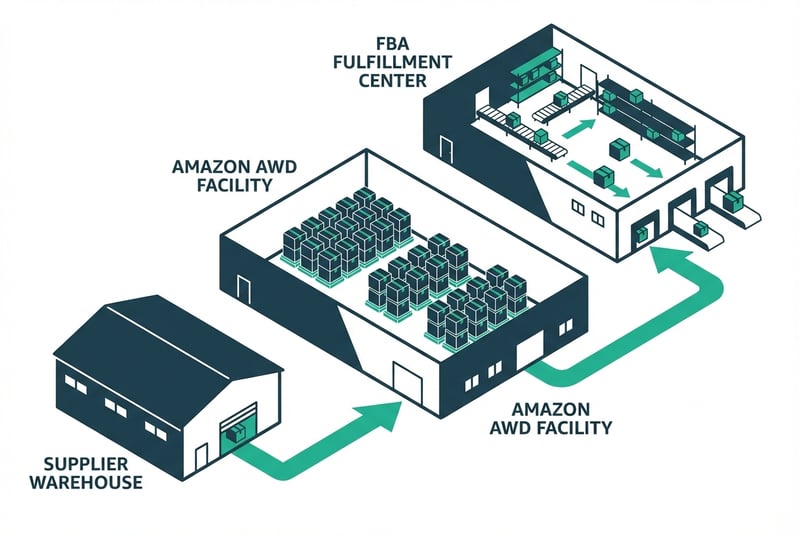
Amazon AWD warehousing flow diagram showing supplier to AWD facility to FBA fulfillment center distribution

How AWD Fits Into Supply Chain by Amazon

Supply Chain by Amazon connects several logistics services into one end-to-end stack. AWD sits in the middle of that stack as the upstream storage node.

A typical flow looks like this:

  • Your supplier ships inventory to an AWD facility (you arrange and pay for that inbound shipment, or use Amazon Global Logistics if shipping from overseas)
  • AWD stores your inventory at a lower per-cubic-foot rate than FBA
  • AWD automatically replenishes FBA as your inventory sells down
  • FBA picks, packs, and ships customer orders

You can also use AWD to distribute inventory to non-Amazon channels, including your own warehouse, a 3PL, wholesalers, or Walmart Fulfillment Services. That multi-channel capability is a newer emphasis in Amazon’s public positioning.

The Difference Between AWD, FBA, and MCF

AWD, FBA, and Multi-Channel Fulfillment (MCF) serve different roles:

AWD stores bulk inventory and replenishes FBA or other destinations. It does not fulfill customer orders directly. You send full pallets or large case quantities. Storage rates are lower than FBA. Processing and transportation fees apply when inventory moves out of AWD.

FBA stores inventory close to customers and fulfills Prime orders with two-day (or faster) delivery. Storage rates are higher than AWD. You pay per-unit fulfillment fees. FBA inventory counts toward your restock limits.

MCF uses the FBA network to fulfill orders from other sales channels like Shopify, Walmart, or your own website. You can configure MCF to use Amazon-branded or blank packaging. MCF pulls from FBA inventory, not AWD inventory.

AWD and FBA work together. AWD reduces how much inventory you hold in FBA at any given time, which lowers your storage fees and helps you stay within restock limits.


How Amazon AWD Works

Sending Bulk Inventory Into AWD

You create an AWD shipment in Seller Central. Amazon assigns an AWD destination facility. You prepare your shipment according to Amazon’s requirements:

  • One SKU per box
  • Box labels and pallet labels applied correctly
  • Shipment sent to the assigned AWD facility (not an FBA facility)

You can ship AWD inventory via your own carrier or use Amazon’s Partnered Carrier Program. You cannot ship AWD and FBA inventory on the same truckload.

Most AWD shipments move by LTL (less-than-truckload) or FTL (full truckload). Some sellers report being able to ship smaller quantities via parcel, but LTL is the standard method. Check current Seller Central guidance before your first shipment. Rules around shipment methods have changed since AWD launched.

How Auto-Replenishment to FBA Works

Once your inventory arrives at AWD, Amazon’s algorithm decides when and how much to replenish into FBA. You do not manually trigger replenishment for most SKUs. Amazon monitors your sales velocity and FBA inventory levels, then transfers cases from AWD to FBA automatically.

You can view auto-replenishment orders in Seller Central. You can also set manual controls at the SKU level if you want to override the default behavior. For example, if you are running a promotion or preparing for a specific event, you can manually request a larger replenishment quantity.

Auto-replenishment aims to keep your FBA stock in the optimal range: enough to avoid stockouts, but not so much that you pay high storage fees or hit restock limits.

How AWD Supports Non-Amazon Channels

AWD can distribute inventory to destinations beyond FBA. Amazon calls this “off-Amazon bulk distribution.”

You can send AWD inventory to:

  • Your own warehouse or 3PL
  • Wholesalers or distributors
  • Other fulfillment networks like Walmart Fulfillment Services

This capability matters if you sell on multiple channels and want to use AWD as a central inventory pool. Instead of splitting safety stock across several locations, you hold bulk inventory in AWD and push it out to each channel as needed.

Multi-channel distribution through AWD is still less common than FBA replenishment. Most sellers use AWD primarily to reduce FBA storage pressure, not to coordinate inventory across several sales channels.


Amazon AWD Fees and Pricing Explained

AWD pricing has three main components: storage fees, processing fees, and transportation fees. The total cost depends on how much inventory you store, how long you store it, and whether you qualify for discount tiers.

Storage Fees

AWD charges storage fees per cubic foot per month. Rates vary by region and discount tier.

Public rates as of early 2026:

West Coast Regions

  • Base: $0.57/cu ft/month
  • Smart Storage Tier: $0.51/cu ft/month
  • Amazon-Managed Tier: $0.46/cu ft/month

Other Regions

  • Base: $0.48/cu ft/month
  • Smart Storage Tier: $0.43/cu ft/month
  • Amazon-Managed Tier: $0.38/cu ft/month

These rates are lower than FBA storage fees, especially during peak season. FBA storage fees rise sharply in Q4. AWD storage fees do not include a holiday surcharge.

Storage is billed based on daily usage. If your inventory sits in AWD for half a month, you pay for half a month.

Inbound and Outbound Processing Fees

AWD charges a processing fee when inventory enters the facility and when it leaves. The public rate is $1.40 per box for inbound processing and $1.40 per box for outbound processing.

Processing fees cover handling, receiving, and loading activities. They are charged per box, not per unit or per cubic foot. If you ship one SKU per box and each box contains 24 units, you pay one $1.40 processing fee for that box on the way in and another $1.40 when it replenishes to FBA.

Transportation Fees

AWD charges a transportation fee when inventory moves from AWD to FBA or another destination. The public rate is $1.40/cu ft (base tier) or $1.26/cu ft (Amazon-managed tier).

Transportation fees depend on distance and cube. Longer hauls cost more. Denser products (more units per cubic foot) spread the transportation cost across more units, which improves your per-unit economics.

How AWD Pricing Compares With FBA and a 3PL

AWD storage fees are lower than FBA storage fees. But AWD adds processing and transportation fees that FBA does not charge separately.

Whether AWD saves you money depends on:

  • How long you store inventory in AWD before it replenishes to FBA
  • How much cube your product occupies relative to its unit count
  • Whether you qualify for discount tiers
  • How much value you get from avoiding FBA restock pressure and inbound placement fees

A 3PL comparison is more complex. Some 3PLs charge lower storage rates than AWD. Some charge higher rates but offer more flexibility, faster hands-on support, or custom services like kitting, bundling, or branded packaging. 3PL pricing also varies widely by location, volume commitment, and service level.

AWD beats a 3PL on cost if your product profile fits AWD’s structure and you value tight integration with FBA. A 3PL beats AWD if you need manual control, custom handling, multi-channel flexibility, or faster exception management.

What Sellers Should Model Before Enrolling

Run a cost model before committing inventory to AWD. Compare your current all-in cost per unit (including FBA storage, inbound placement, and any 3PL fees) against the projected AWD cost per unit.

Key inputs for the model:

  • Current FBA storage cost per unit per month
  • Current inbound placement cost per unit
  • Projected AWD storage duration (how many months between inbound and FBA replenishment)
  • Projected AWD processing and transportation cost per unit
  • Product cube and weight

If your product has low cube, high velocity, and predictable demand, AWD is more likely to produce cost savings. If your product has high cube, low velocity, or unpredictable demand spikes, the AWD fees can outweigh the storage savings.
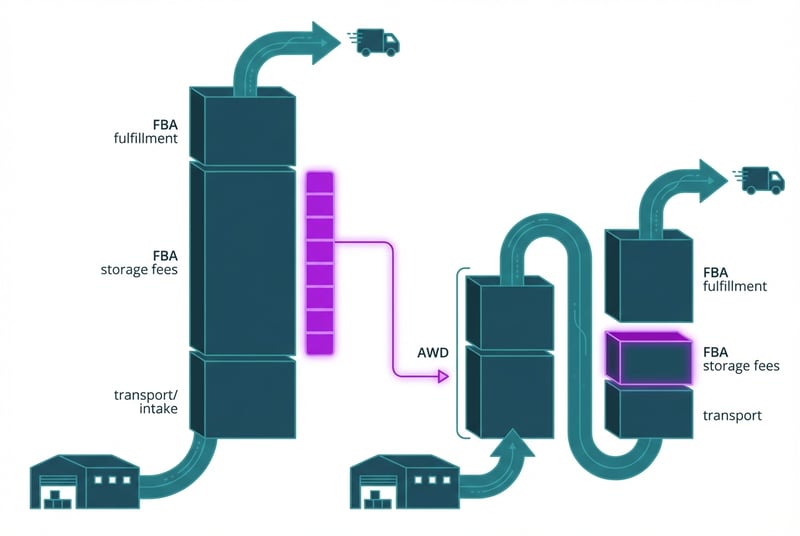
Cost comparison illustration between Amazon FBA-only storage and AWD plus FBA hybrid inventory model


The Biggest Benefits of AWD for Amazon Sellers

Lower Upstream Storage Costs

AWD storage rates are substantially lower than FBA storage rates. That gap widens during Q4 when FBA storage fees climb.

If you buy inventory in bulk to lock in better supplier pricing, AWD gives you a place to store that inventory without paying peak FBA storage fees.

Better In-Stock Protection

AWD auto-replenishment reduces the risk of stockouts caused by FBA receiving delays or restock limit constraints. You hold a larger safety stock in AWD and let Amazon move inventory into FBA as needed.

This matters most for fast-moving SKUs where a stockout kills rank, loses the Buy Box, and disrupts ad campaigns.

Fewer Manual Replenishment Decisions

Auto-replenishment removes some of the daily inventory planning work. You do not have to calculate restock quantities, create shipments, and monitor receiving windows as frequently. Amazon’s algorithm handles replenishment timing and quantities automatically.

This benefit is larger for sellers managing many SKUs. It is smaller for sellers who prefer manual control over replenishment timing.

Potential Inbound Placement Savings

Amazon’s inbound placement fee adds cost when you ship inventory to multiple FBA locations. AWD simplifies that flow. You send one large shipment to one AWD facility. AWD handles distribution into the FBA network without charging a separate inbound placement fee.

The placement fee savings depend on your shipment profile and how much Amazon would have charged for placement under a direct-to-FBA model. For some sellers, this is a material savings. For others, it is negligible.


The Biggest Drawbacks and Risks of AWD

Where Sellers Lose Control

Auto-replenishment shifts control from you to Amazon. Amazon decides when to replenish, how much to replenish, and which FBA facility receives the inventory.

Most of the time, that automation works well. But it can create problems if:

  • You are launching a new product and need inventory in FBA on a specific date
  • You are running a promotion and need a larger-than-normal FBA stock level
  • You are managing a SKU with lumpy demand that Amazon’s algorithm cannot predict accurately

You can override auto-replenishment with manual controls, but that adds back the work AWD is supposed to eliminate.

Channel-Fit Limitations

AWD works best for Amazon-first brands with predictable demand patterns. It works less well for brands that:

  • Sell heavily on non-Amazon channels and need flexible inventory allocation
  • Run frequent promotions with tight launch windows
  • Need custom prep, kitting, or packaging services
  • Require fast hands-on exception handling

AWD is a bulk storage and replenishment system. It is not a full-service 3PL.

Service and Timing Concerns to Watch

AWD receiving times are generally fast, but replenishment from AWD to FBA can take longer than shipping directly to FBA. Some sellers report replenishment transfers taking several days to a week.

That timing lag can cause problems if your FBA inventory runs lower than expected and AWD replenishment does not arrive fast enough. You need to maintain a buffer in FBA to absorb variability in replenishment timing.

Amazon’s service levels and operational consistency have improved since AWD launched, but the program is still newer than FBA. Expect occasional delays, receiving errors, or inventory discrepancies.

Product Eligibility Limits

Not all products are eligible for AWD. Amazon has relaxed some restrictions since launch, but limits still exist.

As of early 2026, AWD generally does not accept:

  • Hazardous materials
  • Products requiring special prep or handling
  • Some high-value or fragile items (check current Seller Central guidance)

Amazon has recently added eligibility for shoes, expiration-dated products, and non-sort conveyable items. But specific eligibility rules vary by product type and may change without notice.

Confirm your SKUs are eligible before sending inventory to AWD. Ineligible products sent to AWD may be refused, returned, or stuck in limbo.


Amazon AWD vs FBA vs 3PL

Choosing between AWD, FBA-only, and a 3PL depends on your inventory profile, sales velocity, channel mix, and control preferences.

When AWD Is the Better Fit

AWD works best if you:

  • Sell primarily on Amazon with predictable demand patterns
  • Buy inventory in bulk to reduce supplier costs
  • Want to reduce FBA storage fees and avoid restock limit constraints
  • Are comfortable with automated replenishment and limited manual control
  • Ship standard-size or sort-conveyable products that meet AWD eligibility criteria
  • Value tight integration with FBA over hands-on 3PL service

Example: A brand selling home goods on Amazon with steady sales velocity, seasonal buying windows, and a preference for low-touch logistics. The brand orders large quantities from overseas suppliers, stores bulk inventory in AWD, and lets auto-replenishment keep FBA stocked year-round.

When a 3PL Is Still the Better Fit

A 3PL works better if you:

  • Sell on multiple channels with complex inventory allocation needs
  • Require custom kitting, bundling, branded packaging, or special prep
  • Need fast hands-on support for exceptions, returns, or inventory audits
  • Want manual control over replenishment timing and quantities
  • Sell products that do not meet AWD eligibility criteria
  • Prefer a relationship with a logistics partner who understands your business model

Example: A brand selling supplements on Amazon, Shopify, and wholesale. The brand requires lot tracking, expiration date management, custom bundling for subscription boxes, and fast turnaround on sample orders. A 3PL with dedicated account management fits better than AWD’s automated system.

When a Hybrid Model Makes Sense

Some sellers use both AWD and a 3PL. They send high-velocity, FBA-only SKUs to AWD and send multi-channel or complex-prep SKUs to a 3PL.

A hybrid model adds operational complexity. You manage two inventory pools, two shipment workflows, and two cost structures. But it can work if the volume and margin justify the extra overhead.


Who Should Use Amazon AWD?

Best-Fit Seller Profiles

AWD is a strong fit for sellers who:

  • Generate $1M+ in annual Amazon revenue with predictable sales patterns
  • Manage 10+ SKUs with steady demand and long selling seasons
  • Buy inventory in bulk from overseas suppliers or domestic distributors
  • Experience FBA restock limits or storage constraints during peak season
  • Prefer low-touch logistics and trust Amazon’s algorithm to manage replenishment
  • Do not require custom prep, kitting, or special handling

AWD also fits sellers who are already using FBA and want to reduce storage costs without changing their fulfillment model. If you are happy with FBA but frustrated by storage fees, inbound placement fees, or restock limits, AWD addresses those pain points directly.

Brands That Should Think Twice

AWD is a weaker fit for sellers who:

  • Sell primarily on non-Amazon channels
  • Launch new products frequently with unpredictable demand
  • Run heavy promotional calendars with tight inventory timing requirements
  • Sell products that require special prep, temperature control, or hazmat handling
  • Need fast hands-on exception management or dedicated account support
  • Prefer manual control over inventory movement and replenishment decisions

If you are a smaller seller (under $500K annual Amazon revenue), AWD’s cost savings may not justify the operational learning curve. Start with FBA-only or a small 3PL relationship until your volume grows.

If you sell in categories with high return rates, short product life cycles, or rapid SKU turnover, AWD’s bulk storage model is less useful. You need more flexibility than AWD’s automated system provides.


How to Enroll in Amazon AWD

Seller Central Path

Enrollment in AWD is straightforward. Most sellers can access AWD directly from Seller Central without a separate application or approval process.

Steps:

  1. Log in to Seller Central
  2. Navigate to Inventory → Manage FBA Inventory
  3. Look for the “Send to Amazon Warehousing & Distribution” option in the shipment creation flow
  4. Follow the prompts to create your first AWD shipment

Amazon may still limit AWD access for some seller accounts based on performance history, account health, or product category. If you do not see the AWD option in Seller Central, contact Seller Support to confirm eligibility.

What to Check Before Your First Shipment

Before sending inventory to AWD:

  • Confirm your SKUs meet AWD eligibility criteria (standard size, no hazmat, no special prep requirements)
  • Run a cost model to verify AWD will reduce your all-in per-unit cost
  • Review Amazon’s current AWD shipment requirements (box labels, pallet labels, one SKU per box)
  • Decide whether you will use your own carrier or Amazon’s Partnered Carrier Program
  • Check your FBA inventory levels to make sure you will not stock out while AWD inventory is in transit or processing

Amazon recommends starting with a small test shipment (one or two pallets) to confirm the process works smoothly before committing a large volume of inventory.


FAQ About Amazon Warehousing and Distribution

Is AWD Cheaper Than FBA?

AWD storage fees are lower than FBA storage fees. But AWD also charges processing and transportation fees that FBA does not charge separately.

Whether AWD is cheaper overall depends on how long you store inventory in AWD, how much cube your product occupies, and whether you qualify for discount tiers. Run a cost model using your actual product and volume data to get an accurate comparison.

Does AWD Replace FBA?

No. AWD does not fulfill customer orders. It stores bulk inventory and replenishes FBA. You still need FBA to fulfill Prime orders with fast delivery.

Think of AWD as an upstream storage layer that reduces how much inventory you hold in FBA at any given time.

Can AWD Fulfill Other Sales Channels?

Yes. AWD can distribute inventory to non-Amazon destinations, including your own warehouse, a 3PL, wholesalers, or other fulfillment networks like Walmart Fulfillment Services.

Multi-channel distribution is less common than FBA replenishment, but it is a supported capability. If you want to use AWD as a central inventory pool for multiple sales channels, you can request distribution to non-Amazon destinations through Seller Central.

What Inventory Is Not Eligible for AWD?

AWD generally does not accept:

  • Hazardous materials
  • Products requiring temperature control or special handling
  • Some high-value or fragile items

Amazon has recently expanded eligibility to include shoes, expiration-dated products, and non-sort conveyable items. Eligibility rules vary by product type and may change without notice. Check the current Seller Central guidance before sending inventory to AWD.

 

Growth chart showing Amazon seller business success through optimized AWD inventory management strategy

Final Take: Is Amazon AWD Worth It in 2026?

Decision Criteria for Operators

AWD is worth using if:

  • Lower storage costs matter more than hands-on control
  • You buy inventory in bulk and need a place to store it outside FBA
  • You trust Amazon’s auto-replenishment algorithm to keep FBA stocked
  • Your products fit AWD’s eligibility criteria
  • You are comfortable with some loss of manual replenishment control

AWD is not worth using if:

  • You need custom prep, kitting, or special handling
  • You sell on multiple channels with complex inventory allocation needs
  • You require fast exception management or dedicated account support
  • Your demand patterns are too unpredictable for automated replenishment
  • The cost model does not show meaningful savings over your current setup

When to Get Expert Help With the Model

If you are managing a large catalog, selling across multiple channels, or unsure whether AWD fits your inventory profile, get help from a logistics consultant or an Amazon agency with supply chain experience.

The right inventory model depends on your unit economics, sales velocity, channel mix, and operational preferences. A generic “AWD is always better” or “3PLs are always better” answer does not exist. You need to model the tradeoffs based on your actual business.

SupplyKick helps brands evaluate inventory strategies, model AWD costs against FBA and 3PL alternatives, and build supply chain plans that support growth without bleeding margin on logistics. If you want help deciding whether AWD fits your business, talk to our team.


Amazon Warehousing and Distribution (AWD): A 2026 Guide for Sellers

SupplyKick
Aug 26, 2020 2:24:03 PM | Updated Mar 19, 2026

Updated March 2026

Amazon sellers managing high inventory volumes face a persistent tension. FBA storage fees climb during peak season. Restock limits tighten when you need space most. Inbound placement fees add cost and complexity. Running out of stock kills momentum. Carrying too much inventory in FBA warehouses drains margin.

Amazon Warehousing and Distribution (AWD) offers one answer to that tension. AWD is an upstream bulk storage layer that sits between your supplier and FBA. You send pallets of inventory to AWD facilities at a lower storage rate than FBA. Amazon holds that inventory and automatically replenishes your FBA stock as it sells. In theory, you reduce storage costs, avoid stockouts, and simplify inbound logistics.

But AWD is not a universal solution. It works well for some sellers and poorly for others. This guide explains what AWD does now in 2026, what it costs, how it compares with FBA-only or a 3PL, and when it makes sense for your business.


What Is Amazon Warehousing and Distribution?

Amazon Warehousing and Distribution (AWD) is a third-party logistics service run by Amazon. It provides low-cost bulk storage and automatic replenishment into FBA. AWD is part of Amazon’s broader Supply Chain by Amazon suite, which also includes Amazon Global Logistics, Buy with Prime, and Multi-Channel Fulfillment.

AWD launched in late 2022 as an invite-only program for select FBA sellers. By 2026, it is available to most Amazon sellers and no longer positioned as an experiment.

Amazon AWD warehousing flow diagram showing supplier to AWD facility to FBA fulfillment center distribution

How AWD Fits Into Supply Chain by Amazon

Supply Chain by Amazon connects several logistics services into one end-to-end stack. AWD sits in the middle of that stack as the upstream storage node.

A typical flow looks like this:

  • Your supplier ships inventory to an AWD facility (you arrange and pay for that inbound shipment, or use Amazon Global Logistics if shipping from overseas)
  • AWD stores your inventory at a lower per-cubic-foot rate than FBA
  • AWD automatically replenishes FBA as your inventory sells down
  • FBA picks, packs, and ships customer orders

You can also use AWD to distribute inventory to non-Amazon channels, including your own warehouse, a 3PL, wholesalers, or Walmart Fulfillment Services. That multi-channel capability is a newer emphasis in Amazon’s public positioning.

The Difference Between AWD, FBA, and MCF

AWD, FBA, and Multi-Channel Fulfillment (MCF) serve different roles:

AWD stores bulk inventory and replenishes FBA or other destinations. It does not fulfill customer orders directly. You send full pallets or large case quantities. Storage rates are lower than FBA. Processing and transportation fees apply when inventory moves out of AWD.

FBA stores inventory close to customers and fulfills Prime orders with two-day (or faster) delivery. Storage rates are higher than AWD. You pay per-unit fulfillment fees. FBA inventory counts toward your restock limits.

MCF uses the FBA network to fulfill orders from other sales channels like Shopify, Walmart, or your own website. You can configure MCF to use Amazon-branded or blank packaging. MCF pulls from FBA inventory, not AWD inventory.

AWD and FBA work together. AWD reduces how much inventory you hold in FBA at any given time, which lowers your storage fees and helps you stay within restock limits.


How Amazon AWD Works

Sending Bulk Inventory Into AWD

You create an AWD shipment in Seller Central. Amazon assigns an AWD destination facility. You prepare your shipment according to Amazon’s requirements:

  • One SKU per box
  • Box labels and pallet labels applied correctly
  • Shipment sent to the assigned AWD facility (not an FBA facility)

You can ship AWD inventory via your own carrier or use Amazon’s Partnered Carrier Program. You cannot ship AWD and FBA inventory on the same truckload.

Most AWD shipments move by LTL (less-than-truckload) or FTL (full truckload). Some sellers report being able to ship smaller quantities via parcel, but LTL is the standard method. Check current Seller Central guidance before your first shipment. Rules around shipment methods have changed since AWD launched.

How Auto-Replenishment to FBA Works

Once your inventory arrives at AWD, Amazon’s algorithm decides when and how much to replenish into FBA. You do not manually trigger replenishment for most SKUs. Amazon monitors your sales velocity and FBA inventory levels, then transfers cases from AWD to FBA automatically.

You can view auto-replenishment orders in Seller Central. You can also set manual controls at the SKU level if you want to override the default behavior. For example, if you are running a promotion or preparing for a specific event, you can manually request a larger replenishment quantity.

Auto-replenishment aims to keep your FBA stock in the optimal range: enough to avoid stockouts, but not so much that you pay high storage fees or hit restock limits.

How AWD Supports Non-Amazon Channels

AWD can distribute inventory to destinations beyond FBA. Amazon calls this “off-Amazon bulk distribution.”

You can send AWD inventory to:

  • Your own warehouse or 3PL
  • Wholesalers or distributors
  • Other fulfillment networks like Walmart Fulfillment Services

This capability matters if you sell on multiple channels and want to use AWD as a central inventory pool. Instead of splitting safety stock across several locations, you hold bulk inventory in AWD and push it out to each channel as needed.

Multi-channel distribution through AWD is still less common than FBA replenishment. Most sellers use AWD primarily to reduce FBA storage pressure, not to coordinate inventory across several sales channels.


Amazon AWD Fees and Pricing Explained

AWD pricing has three main components: storage fees, processing fees, and transportation fees. The total cost depends on how much inventory you store, how long you store it, and whether you qualify for discount tiers.

Storage Fees

AWD charges storage fees per cubic foot per month. Rates vary by region and discount tier.

Public rates as of early 2026:

West Coast Regions

  • Base: $0.57/cu ft/month
  • Smart Storage Tier: $0.51/cu ft/month
  • Amazon-Managed Tier: $0.46/cu ft/month

Other Regions

  • Base: $0.48/cu ft/month
  • Smart Storage Tier: $0.43/cu ft/month
  • Amazon-Managed Tier: $0.38/cu ft/month

These rates are lower than FBA storage fees, especially during peak season. FBA storage fees rise sharply in Q4. AWD storage fees do not include a holiday surcharge.

Storage is billed based on daily usage. If your inventory sits in AWD for half a month, you pay for half a month.

Inbound and Outbound Processing Fees

AWD charges a processing fee when inventory enters the facility and when it leaves. The public rate is $1.40 per box for inbound processing and $1.40 per box for outbound processing.

Processing fees cover handling, receiving, and loading activities. They are charged per box, not per unit or per cubic foot. If you ship one SKU per box and each box contains 24 units, you pay one $1.40 processing fee for that box on the way in and another $1.40 when it replenishes to FBA.

Transportation Fees

AWD charges a transportation fee when inventory moves from AWD to FBA or another destination. The public rate is $1.40/cu ft (base tier) or $1.26/cu ft (Amazon-managed tier).

Transportation fees depend on distance and cube. Longer hauls cost more. Denser products (more units per cubic foot) spread the transportation cost across more units, which improves your per-unit economics.

How AWD Pricing Compares With FBA and a 3PL

AWD storage fees are lower than FBA storage fees. But AWD adds processing and transportation fees that FBA does not charge separately.

Whether AWD saves you money depends on:

  • How long you store inventory in AWD before it replenishes to FBA
  • How much cube your product occupies relative to its unit count
  • Whether you qualify for discount tiers
  • How much value you get from avoiding FBA restock pressure and inbound placement fees

A 3PL comparison is more complex. Some 3PLs charge lower storage rates than AWD. Some charge higher rates but offer more flexibility, faster hands-on support, or custom services like kitting, bundling, or branded packaging. 3PL pricing also varies widely by location, volume commitment, and service level.

AWD beats a 3PL on cost if your product profile fits AWD’s structure and you value tight integration with FBA. A 3PL beats AWD if you need manual control, custom handling, multi-channel flexibility, or faster exception management.

What Sellers Should Model Before Enrolling

Run a cost model before committing inventory to AWD. Compare your current all-in cost per unit (including FBA storage, inbound placement, and any 3PL fees) against the projected AWD cost per unit.

Key inputs for the model:

  • Current FBA storage cost per unit per month
  • Current inbound placement cost per unit
  • Projected AWD storage duration (how many months between inbound and FBA replenishment)
  • Projected AWD processing and transportation cost per unit
  • Product cube and weight

If your product has low cube, high velocity, and predictable demand, AWD is more likely to produce cost savings. If your product has high cube, low velocity, or unpredictable demand spikes, the AWD fees can outweigh the storage savings.

Cost comparison illustration between Amazon FBA-only storage and AWD plus FBA hybrid inventory model


The Biggest Benefits of AWD for Amazon Sellers

Lower Upstream Storage Costs

AWD storage rates are substantially lower than FBA storage rates. That gap widens during Q4 when FBA storage fees climb.

If you buy inventory in bulk to lock in better supplier pricing, AWD gives you a place to store that inventory without paying peak FBA storage fees.

Better In-Stock Protection

AWD auto-replenishment reduces the risk of stockouts caused by FBA receiving delays or restock limit constraints. You hold a larger safety stock in AWD and let Amazon move inventory into FBA as needed.

This matters most for fast-moving SKUs where a stockout kills rank, loses the Buy Box, and disrupts ad campaigns.

Fewer Manual Replenishment Decisions

Auto-replenishment removes some of the daily inventory planning work. You do not have to calculate restock quantities, create shipments, and monitor receiving windows as frequently. Amazon’s algorithm handles replenishment timing and quantities automatically.

This benefit is larger for sellers managing many SKUs. It is smaller for sellers who prefer manual control over replenishment timing.

Potential Inbound Placement Savings

Amazon’s inbound placement fee adds cost when you ship inventory to multiple FBA locations. AWD simplifies that flow. You send one large shipment to one AWD facility. AWD handles distribution into the FBA network without charging a separate inbound placement fee.

The placement fee savings depend on your shipment profile and how much Amazon would have charged for placement under a direct-to-FBA model. For some sellers, this is a material savings. For others, it is negligible.


The Biggest Drawbacks and Risks of AWD

Where Sellers Lose Control

Auto-replenishment shifts control from you to Amazon. Amazon decides when to replenish, how much to replenish, and which FBA facility receives the inventory.

Most of the time, that automation works well. But it can create problems if:

  • You are launching a new product and need inventory in FBA on a specific date
  • You are running a promotion and need a larger-than-normal FBA stock level
  • You are managing a SKU with lumpy demand that Amazon’s algorithm cannot predict accurately

You can override auto-replenishment with manual controls, but that adds back the work AWD is supposed to eliminate.

Channel-Fit Limitations

AWD works best for Amazon-first brands with predictable demand patterns. It works less well for brands that:

  • Sell heavily on non-Amazon channels and need flexible inventory allocation
  • Run frequent promotions with tight launch windows
  • Need custom prep, kitting, or packaging services
  • Require fast hands-on exception handling

AWD is a bulk storage and replenishment system. It is not a full-service 3PL.

Service and Timing Concerns to Watch

AWD receiving times are generally fast, but replenishment from AWD to FBA can take longer than shipping directly to FBA. Some sellers report replenishment transfers taking several days to a week.

That timing lag can cause problems if your FBA inventory runs lower than expected and AWD replenishment does not arrive fast enough. You need to maintain a buffer in FBA to absorb variability in replenishment timing.

Amazon’s service levels and operational consistency have improved since AWD launched, but the program is still newer than FBA. Expect occasional delays, receiving errors, or inventory discrepancies.

Product Eligibility Limits

Not all products are eligible for AWD. Amazon has relaxed some restrictions since launch, but limits still exist.

As of early 2026, AWD generally does not accept:

  • Hazardous materials
  • Products requiring special prep or handling
  • Some high-value or fragile items (check current Seller Central guidance)

Amazon has recently added eligibility for shoes, expiration-dated products, and non-sort conveyable items. But specific eligibility rules vary by product type and may change without notice.

Confirm your SKUs are eligible before sending inventory to AWD. Ineligible products sent to AWD may be refused, returned, or stuck in limbo.


Amazon AWD vs FBA vs 3PL

Choosing between AWD, FBA-only, and a 3PL depends on your inventory profile, sales velocity, channel mix, and control preferences.

When AWD Is the Better Fit

AWD works best if you:

  • Sell primarily on Amazon with predictable demand patterns
  • Buy inventory in bulk to reduce supplier costs
  • Want to reduce FBA storage fees and avoid restock limit constraints
  • Are comfortable with automated replenishment and limited manual control
  • Ship standard-size or sort-conveyable products that meet AWD eligibility criteria
  • Value tight integration with FBA over hands-on 3PL service

Example: A brand selling home goods on Amazon with steady sales velocity, seasonal buying windows, and a preference for low-touch logistics. The brand orders large quantities from overseas suppliers, stores bulk inventory in AWD, and lets auto-replenishment keep FBA stocked year-round.

When a 3PL Is Still the Better Fit

A 3PL works better if you:

  • Sell on multiple channels with complex inventory allocation needs
  • Require custom kitting, bundling, branded packaging, or special prep
  • Need fast hands-on support for exceptions, returns, or inventory audits
  • Want manual control over replenishment timing and quantities
  • Sell products that do not meet AWD eligibility criteria
  • Prefer a relationship with a logistics partner who understands your business model

Example: A brand selling supplements on Amazon, Shopify, and wholesale. The brand requires lot tracking, expiration date management, custom bundling for subscription boxes, and fast turnaround on sample orders. A 3PL with dedicated account management fits better than AWD’s automated system.

When a Hybrid Model Makes Sense

Some sellers use both AWD and a 3PL. They send high-velocity, FBA-only SKUs to AWD and send multi-channel or complex-prep SKUs to a 3PL.

A hybrid model adds operational complexity. You manage two inventory pools, two shipment workflows, and two cost structures. But it can work if the volume and margin justify the extra overhead.


Who Should Use Amazon AWD?

Best-Fit Seller Profiles

AWD is a strong fit for sellers who:

  • Generate $1M+ in annual Amazon revenue with predictable sales patterns
  • Manage 10+ SKUs with steady demand and long selling seasons
  • Buy inventory in bulk from overseas suppliers or domestic distributors
  • Experience FBA restock limits or storage constraints during peak season
  • Prefer low-touch logistics and trust Amazon’s algorithm to manage replenishment
  • Do not require custom prep, kitting, or special handling

AWD also fits sellers who are already using FBA and want to reduce storage costs without changing their fulfillment model. If you are happy with FBA but frustrated by storage fees, inbound placement fees, or restock limits, AWD addresses those pain points directly.

Brands That Should Think Twice

AWD is a weaker fit for sellers who:

  • Sell primarily on non-Amazon channels
  • Launch new products frequently with unpredictable demand
  • Run heavy promotional calendars with tight inventory timing requirements
  • Sell products that require special prep, temperature control, or hazmat handling
  • Need fast hands-on exception management or dedicated account support
  • Prefer manual control over inventory movement and replenishment decisions

If you are a smaller seller (under $500K annual Amazon revenue), AWD’s cost savings may not justify the operational learning curve. Start with FBA-only or a small 3PL relationship until your volume grows.

If you sell in categories with high return rates, short product life cycles, or rapid SKU turnover, AWD’s bulk storage model is less useful. You need more flexibility than AWD’s automated system provides.


How to Enroll in Amazon AWD

Seller Central Path

Enrollment in AWD is straightforward. Most sellers can access AWD directly from Seller Central without a separate application or approval process.

Steps:

  1. Log in to Seller Central
  2. Navigate to Inventory → Manage FBA Inventory
  3. Look for the “Send to Amazon Warehousing & Distribution” option in the shipment creation flow
  4. Follow the prompts to create your first AWD shipment

Amazon may still limit AWD access for some seller accounts based on performance history, account health, or product category. If you do not see the AWD option in Seller Central, contact Seller Support to confirm eligibility.

What to Check Before Your First Shipment

Before sending inventory to AWD:

  • Confirm your SKUs meet AWD eligibility criteria (standard size, no hazmat, no special prep requirements)
  • Run a cost model to verify AWD will reduce your all-in per-unit cost
  • Review Amazon’s current AWD shipment requirements (box labels, pallet labels, one SKU per box)
  • Decide whether you will use your own carrier or Amazon’s Partnered Carrier Program
  • Check your FBA inventory levels to make sure you will not stock out while AWD inventory is in transit or processing

Amazon recommends starting with a small test shipment (one or two pallets) to confirm the process works smoothly before committing a large volume of inventory.


FAQ About Amazon Warehousing and Distribution

Is AWD Cheaper Than FBA?

AWD storage fees are lower than FBA storage fees. But AWD also charges processing and transportation fees that FBA does not charge separately.

Whether AWD is cheaper overall depends on how long you store inventory in AWD, how much cube your product occupies, and whether you qualify for discount tiers. Run a cost model using your actual product and volume data to get an accurate comparison.

Does AWD Replace FBA?

No. AWD does not fulfill customer orders. It stores bulk inventory and replenishes FBA. You still need FBA to fulfill Prime orders with fast delivery.

Think of AWD as an upstream storage layer that reduces how much inventory you hold in FBA at any given time.

Can AWD Fulfill Other Sales Channels?

Yes. AWD can distribute inventory to non-Amazon destinations, including your own warehouse, a 3PL, wholesalers, or other fulfillment networks like Walmart Fulfillment Services.

Multi-channel distribution is less common than FBA replenishment, but it is a supported capability. If you want to use AWD as a central inventory pool for multiple sales channels, you can request distribution to non-Amazon destinations through Seller Central.

What Inventory Is Not Eligible for AWD?

AWD generally does not accept:

  • Hazardous materials
  • Products requiring temperature control or special handling
  • Some high-value or fragile items

Amazon has recently expanded eligibility to include shoes, expiration-dated products, and non-sort conveyable items. Eligibility rules vary by product type and may change without notice. Check the current Seller Central guidance before sending inventory to AWD.


Growth chart showing Amazon seller business success through optimized AWD inventory management strategy

Final Take: Is Amazon AWD Worth It in 2026?

Decision Criteria for Operators

AWD is worth using if:

  • Lower storage costs matter more than hands-on control
  • You buy inventory in bulk and need a place to store it outside FBA
  • You trust Amazon’s auto-replenishment algorithm to keep FBA stocked
  • Your products fit AWD’s eligibility criteria
  • You are comfortable with some loss of manual replenishment control

AWD is not worth using if:

  • You need custom prep, kitting, or special handling
  • You sell on multiple channels with complex inventory allocation needs
  • You require fast exception management or dedicated account support
  • Your demand patterns are too unpredictable for automated replenishment
  • The cost model does not show meaningful savings over your current setup

When to Get Expert Help With the Model

If you are managing a large catalog, selling across multiple channels, or unsure whether AWD fits your inventory profile, get help from a logistics consultant or an Amazon agency with supply chain experience.

The right inventory model depends on your unit economics, sales velocity, channel mix, and operational preferences. A generic “AWD is always better” or “3PLs are always better” answer does not exist. You need to model the tradeoffs based on your actual business.

SupplyKick helps brands evaluate inventory strategies, model AWD costs against FBA and 3PL alternatives, and build supply chain plans that support growth without bleeding margin on logistics. If you want help deciding whether AWD fits your business, talk to our team.
SupplyKick Newsletter: Amazon Growth Strategies and News

Stay up to date with all things Amazon.

Sign up to receive our newsletter for growth strategies, important updates, inventory and policy changes, and best practices.