/Logos/SupplyKick_Logo.svg "SupplyKick_Logo")


You can run the best Amazon advertising campaign of the year, update every listing detail, and price your products perfectly. None of it matters if shoppers hit "Add to Cart" and see "Currently unavailable."
Inventory planning decides whether you capitalize on demand or watch competitors take your sales. Amazon's major shopping windows (Prime Day, Prime Big Deal Days, Black Friday, Cyber Monday, and the full Q4 stretch) require sellers to move inventory weeks before the traffic arrives. Miss the receiving window and you're out of stock when conversion rates peak.
This calendar covers the dates and deadlines Amazon sellers need for 2026. Some dates are confirmed. Others are still estimates based on Amazon's historical patterns. We'll tell you which is which.
Current Status as of March 12, 2026
Amazon has not announced official 2026 Prime Day or Prime Big Deal Days dates yet. This guide uses historical event timing to help sellers plan ahead. We'll update this page when Amazon confirms official dates.
In This Guide
Amazon Seller Calendar 2026 at a Glance
| Event or Season | 2026 Date / Window | Status | Start Planning By | FBA Send-In Target |
|---|---|---|---|---|
| Spring holidays (St. Patrick's, Easter) | Mar 1 – Apr 20 | Confirmed | January 1 | Mid-January |
| Mother's Day | May 10 | Confirmed | March 15 | Late March |
| Memorial Day | May 25 | Confirmed | April 1 | Mid-April |
| Father's Day | June 21 | Confirmed | May 1 | Early June |
| Prime Day | Mid-July (estimated) | TBD by Amazon | May 1 | Early June |
| Independence Day | July 4 | Confirmed | May 15 | Mid-June |
| Back to School | Jul 15 – Sep 10 | Estimated | June 1 | Late June |
| Labor Day | September 7 | Confirmed | July 15 | Late July |
| Prime Big Deal Days | Early-to-mid October (estimated) | TBD by Amazon | August 1 | Early September |
| Q4 holiday season | Oct 1 – Dec 31 | Estimated | August 15 | Early September |
| Halloween | October 31 | Confirmed | September 1 | Mid-September |
| Black Friday | November 27 | Confirmed | October 1 | Early November |
| Cyber Monday | November 30 | Confirmed | October 1 | Early November |
| Christmas | December 25 | Confirmed | October 1 | Early November |
| New Year's Day | January 1, 2027 | Confirmed | November 1 | Mid-November |
| Valentine's Day | February 14, 2027 | Confirmed | December 15 | Early January 2027 |
"Start Planning By" dates assume conservative lead times. Adjust earlier for LTL shipments, international sourcing, or products with long manufacturing cycles. "FBA Send-In Target" dates account for Amazon's typical 2 to 3 week receiving window plus safety buffer.
How to Use This Calendar for FBA Inventory Planning
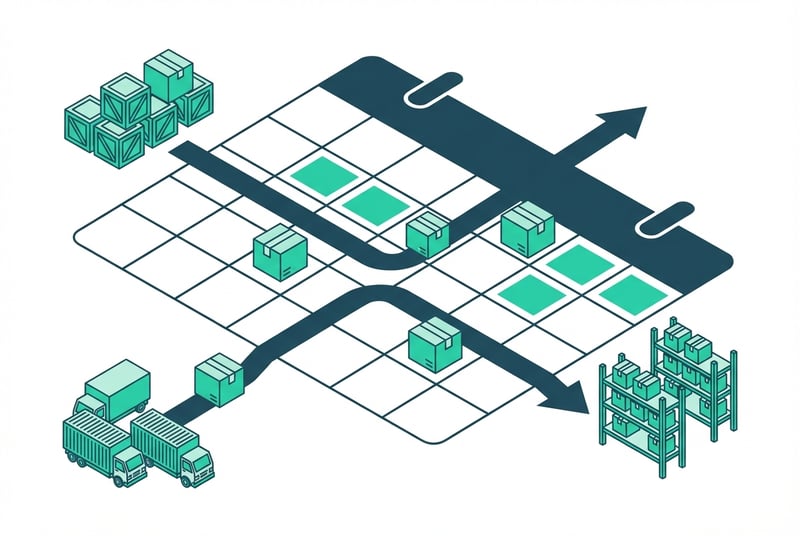
This calendar is a starting point, not a rulebook. Your actual send-in timing depends on how you ship, where you source, and how much risk you're willing to accept.
Parcel vs LTL vs AWD Lead Times
Parcel shipments typically take one week from ship to received at Amazon. That includes transit time plus Amazon's processing time. Parcel gives you the tightest planning window, but it's expensive for high-volume shipments.
LTL (Less-Than-Truckload) shipments take two to three weeks, sometimes longer if Amazon's fulfillment centers are backed up. Budget three weeks minimum. If you're planning for a major event like Prime Day or Black Friday, add another week as buffer.
AWD (Amazon Warehousing & Distribution) changes the math. AWD is bulk storage upstream from FBA. Amazon auto-replenishes your FBA inventory from AWD as units sell. You avoid the rush to ship everything directly into fulfillment centers right before peak season. AWD also has no added holiday surcharges. If you carry deep inventory and want protection against Q4 stockouts, AWD is worth reviewing.
How to Build a Conservative Send-In Window
Start with the demand date. Count backward based on your shipment method:
Send-In Window Calculator
- Parcel: Event date minus 1 week (transit/receiving) minus 1 week (safety buffer) = ship by 2 weeks before event
- LTL: Event date minus 3 weeks (transit/receiving) minus 1 week (safety buffer) = ship by 4 weeks before event
- International or AWD: Add sourcing/transit time to the above
Example: If Prime Day 2026 lands on July 15 (estimated), parcel sellers should ship by early July. LTL sellers should ship by mid-June. Sellers importing from Asia should finalize production and shipping by late May.
Amazon's fulfillment centers slow down during peak periods. They prioritize outbound orders over receiving new inventory. That's why the table above builds in conservative buffers. If you cut it close and Amazon's receiving takes four weeks instead of two, you'll miss the event.
What to Do When Amazon Hasn't Announced Dates Yet
As of March 2026, Amazon has not confirmed Prime Day or Prime Big Deal Days dates. Here's how to plan anyway:
Use historical timing as your baseline. Prime Day 2025 ran July 8 to 11. Prime Big Deal Days 2025 ran October 7 to 8. Assume 2026 will land in similar windows unless Amazon signals otherwise.
Build your plan around the estimated window, then adjust when Amazon announces. Don't wait for confirmation to start forecasting inventory, prepping listings, or scheduling manufacturing. Lock your plan to the historical window, then shift dates by a few days once Amazon posts the official calendar.
Submit deals as soon as deal windows open. Amazon typically opens Prime Day deal submissions 4 to 6 weeks before the event. Watch Seller Central for the submission window and get your deals in early. Waiting until the last minute risks approval delays or missing the cutoff.
Communicate the uncertainty to your supply chain. Tell your manufacturer, freight forwarder, and 3PL that your target date is an estimate. Build contingency plans for scenarios where Amazon announces dates earlier or later than expected.
Need Help Planning Your FBA Calendar?
Our team coordinates inventory timing with ad spend, promotions, and seasonal demand to keep your products in stock when it counts.
Connect With Our TeamKey Amazon Seller Dates in H1 2026
Q1 Demand Windows
Spring holidays: St. Patrick's Day (March 17), Easter (April 20), and spring break season (March through early April) drive sales in categories like apparel, outdoor gear, travel accessories, home decor, and party supplies. Ship inventory by mid-January if you're targeting this window.
Valentine's Day (February 14): This falls outside the current calendar year but affects H1 2026 planning if you're selling gifts, apparel, or home goods. Ship by early January to catch Valentine's demand.
Spring and Early Summer Events
Mother's Day (May 10) and Father's Day (June 21) are gift-driven shopping windows. Categories like jewelry, apparel, tools, electronics, and personalized items see spikes. Ship Mother's Day inventory by late March. Ship Father's Day inventory by early June.
Memorial Day (May 25) kicks off outdoor and summer product demand. Categories like grills, outdoor furniture, coolers, and sports equipment see increased traffic. Ship by mid-April.
Independence Day (July 4) overlaps with early summer demand and often sits close to Prime Day. If your products fit July 4 shopping behavior (outdoor, party, patriotic themes), plan inventory that covers both July 4 and Prime Day in one shipment window. Ship by mid-June.
What to Watch Before Prime Day Planning Opens
Amazon typically announces Prime Day 4 to 6 weeks before the event. In 2025, Amazon announced dates in early June for a mid-July event. Expect similar timing in 2026.
Before Amazon announces:
- Finalize your product assortment and inventory forecast based on historical Prime Day performance
- Prep listing updates: titles, bullets, A+ Content, images, video
- Draft your Lightning Deal and Prime Exclusive Discount submissions so you can submit the moment deal windows open
- Lock your advertising budget and campaign structure
- Confirm your supply chain can hit early-June ship dates for mid-July demand
Prime Day 2026 Prep Timeline
Prime Day 2025 ran July 8 to 11. That's four days, up from the traditional two-day format. Assume Prime Day 2026 will follow a similar multi-day structure unless Amazon signals a change. This means you need deeper inventory coverage, longer ad budget pacing, and more post-event stock to handle continued demand after the event closes.
As of March 12, 2026, Amazon has not announced official Prime Day 2026 dates. Plan for mid-July based on historical timing.
Deal Submission and Promo Planning Windows
Deal submission windows typically open 4 to 6 weeks before Prime Day. Watch Seller Central for the announcement. Submit Lightning Deals and Prime Exclusive Discounts as soon as the window opens. Don't wait until the deadline. Amazon reviews deal submissions on a rolling basis, and popular time slots fill fast.
Coupons and promotions can be created anytime, but coordinate coupon timing with your deal schedule. If you're running a Lightning Deal, pair it with a post-deal coupon to keep conversion rates high after your deal slot ends.
Inventory and Ad Prep Checkpoints
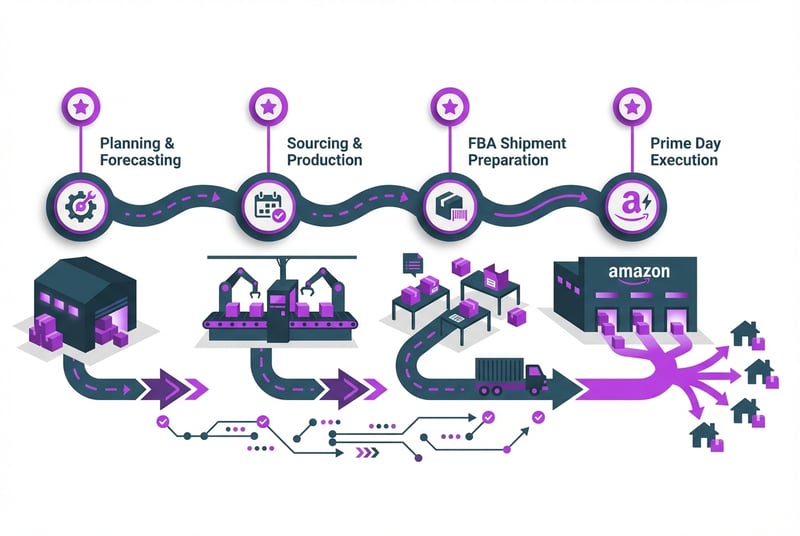
8 weeks before estimated Prime Day (mid-May)
- Finalize inventory forecast based on last year's Prime Day sales, current sell-through rate, and planned promo depth
- Confirm manufacturing and shipping timelines
- Review current FBA inventory levels and identify gaps
6 weeks before (early June)
- Ship parcel inventory
- Submit deal applications as soon as Seller Central opens the window
- Finalize listing updates: A+ Content, product video, images, bullet copy
- Launch pre-Prime Day advertising campaigns to build momentum
4 weeks before (late June)
- Ship LTL inventory (latest safe date)
- Confirm all deal submissions are approved
- Review advertising bids and budgets
- Check that all listing updates are live
2 weeks before (early July)
- Verify FBA inventory is received and available
- Monitor receiving status in Seller Central and escalate any delays
- Finalize ad budgets and dayparting strategy
- Prep post-event inventory replenishment plan
During Prime Day
- Monitor stock levels hourly
- Adjust ad spend based on performance and stock availability
- Respond to customer questions quickly to protect conversion rate
What to Update Once Amazon Confirms Official Dates
When Amazon announces Prime Day 2026:
- Adjust your send-in calendar by the number of days between estimated and confirmed dates
- Update deal submission deadlines based on Amazon's official timeline
- Communicate new dates to your supply chain, freight forwarder, and warehouse partners
- Revise ad campaign scheduling to match the confirmed event window
Q4 2026 Amazon Peak Season Timeline
Q4 is not just Black Friday and Cyber Monday. Peak season starts October 1 and runs through New Year's Day. Sellers who treat Q4 as one continuous high-demand period, not a series of isolated shopping days, protect in-stock rate better and capture more total sales.
Prime Big Deal Days
Amazon launched Prime Big Deal Days in October 2023 as an early-holiday kickoff event. The event returned in 2024 and 2025. Assume Amazon will run it again in 2026, likely in early-to-mid October.
Prime Big Deal Days 2025 ran October 7 to 8. As of March 12, 2026, Amazon has not announced 2026 dates. Plan for early October based on historical timing.
Prime Big Deal Days functions like a smaller Prime Day. It's a 48-hour members-only sale with Lightning Deals, Prime Exclusive Discounts, and heavy on-platform promotion. Sellers who participate see traffic spikes and conversion lift.
Inventory timing: Ship by early September to ensure stock is received before Prime Big Deal Days and available through the rest of Q4. Don't split your Q4 inventory into separate Prime Big Deal Days and Black Friday shipments. Ship one large batch in early September and let it cover the entire peak season.
Deal prep: Amazon typically opens Prime Big Deal Days deal submissions in late August or early September. Submit deals as soon as the window opens.
Black Friday and Cyber Monday
Black Friday 2026 is November 27. Cyber Monday is November 30.
These are the two highest-traffic shopping days of the year. Amazon promotes deals heavily across the platform, and off-Amazon advertising (Google, Meta, TV) drives additional traffic to Amazon. Sellers who are in stock and running promotions see conversion rates 2 to 3x higher than normal.
Inventory timing: Ship by early November at the latest. If you're shipping LTL or importing, ship by mid-October. Amazon's fulfillment centers get backed up in November, and receiving times stretch longer than normal.
Promotion strategy: Lightning Deals sell out fast on Black Friday and Cyber Monday. If you get a Lightning Deal slot, make sure your inventory can handle 10 to 20x normal daily sales during your deal window. If you don't get a Lightning Deal, run coupons and Prime Exclusive Discounts to stay competitive.
Advertising: Start Black Friday ad campaigns the week of Thanksgiving, not on Black Friday itself. Amazon recommended this timing in 2025, and sellers who followed it saw better performance than those who waited until Friday morning. Budget for elevated CPCs. Everyone is bidding higher during peak days.
Christmas and Year-End Inventory Protection
Amazon's last guaranteed delivery date for Christmas varies by region and Prime membership status. Assume the practical cutoff for most sellers is around December 18 to 20. After that, shoppers shift to digital products, gift cards, or local pickup.
Post-Christmas demand: Don't assume demand stops on December 26. Many shoppers use gift cards, cash gifts, and post-holiday sales to buy products for themselves. Keep inventory available through New Year's Day.
Year-end inventory risk: If you over-ordered for Q4 and have excess inventory sitting in FBA after New Year's, you'll hit long-term storage fees in mid-January. Review your inventory levels in late December and create removal orders or run clearance promotions to avoid unnecessary fees.
2026 Amazon Seller Checklist
Use this checklist to prepare for Prime Day, Prime Big Deal Days, and Q4. Adjust timing based on your shipment method and product category.
Inventory Forecasting
- Review past 12 months of sales data to identify seasonality patterns
- Calculate target stock levels for peak events based on historical sales lift
- Identify best-selling SKUs and prioritize inventory depth for those products
- Confirm manufacturing lead times and freight transit times
- Build safety stock buffer for high-velocity SKUs
- Decide on parcel vs LTL vs AWD based on volume and cost
- Create shipment plan and lock ship dates in calendar
- Monitor receiving times in Seller Central and escalate delays immediately
Listing and Creative Prep
- Update product titles with relevant keywords for seasonal demand
- Rewrite bullet points to highlight features that matter during peak season (gift-ready, fast delivery, holiday use cases)
- Upload new product images if existing images are outdated or low-quality
- Create or update product video showing product in use
- Update A+ Content with seasonal messaging and visuals
- Enable product variations to cross-sell related SKUs
- Review and respond to recent customer questions on listings
- Check for suppressed listings or listing errors in Seller Central
Advertising and Promotion Planning
- Set advertising budget for Prime Day, Prime Big Deal Days, Black Friday, Cyber Monday, and full Q4
- Launch pre-event Sponsored Product and Sponsored Brand campaigns 2 to 4 weeks before each major event
- Submit Lightning Deal applications as soon as deal windows open
- Create Prime Exclusive Discounts for events where Lightning Deals aren't available
- Set up coupons to run post-deal or alongside non-deal products
- Review advertising bids and increase bids for high-intent keywords during peak days
- Enable Sponsored Display retargeting campaigns to recapture browsers who didn't convert
- Monitor ACOS daily during events and adjust bids in real time
Pricing and Margin Review
- Review current landed cost per unit (product cost + freight + FBA fees)
- Calculate break-even price and minimum profitable price for each SKU
- Confirm 2026 FBA fee changes and update pricing if necessary
- Decide on discount depth for Lightning Deals and coupons (balance margin vs conversion lift)
- Check competitor pricing and adjust your pricing to stay competitive without racing to the bottom
- Enable automate pricing rules if you want dynamic repricing during peak traffic
- Plan for post-event pricing: will you hold promo pricing or return to normal price after the event?
FAQ About the 2026 Amazon Seller Calendar
When should I send inventory to Amazon FBA for Prime Day 2026?
Ship parcel inventory by early June. Ship LTL inventory by mid-to-late May. Amazon hasn't announced official Prime Day 2026 dates yet, but historical timing suggests mid-July. Amazon's fulfillment centers take 2 to 3 weeks to receive and process inventory, and that timeline stretches during peak periods. Add a safety buffer to avoid missing the event.
When does Amazon peak season start for sellers?
Peak season starts October 1 and runs through December 31. Prime Big Deal Days typically kicks off in early October, followed by Black Friday, Cyber Monday, and the full holiday shopping stretch. Don't treat Q4 as a series of isolated events. Ship one large inventory batch in early September to cover the entire peak season.
What are the most important Amazon seller dates in 2026?
Prime Day (estimated mid-July), Prime Big Deal Days (estimated early October), Black Friday (November 27), and Cyber Monday (November 30). These four events generate the highest traffic and conversion rates of the year. After that, Mother's Day, Father's Day, and Back to School are secondary peaks for specific categories.
How early should sellers prepare inventory for Black Friday and Cyber Monday?
Ship by early November at the latest. If you're using LTL or importing inventory, ship by mid-October. Amazon's receiving times slow down in November, and missing the receiving window means you're out of stock during the highest-traffic shopping days of the year.
What is the difference between confirmed Amazon event dates and projected planning windows?
Confirmed dates are official: holidays like Black Friday (November 27, 2026) and Christmas (December 25) don't change. Projected planning windows are estimates based on Amazon's historical event timing. Amazon hasn't announced Prime Day 2026 or Prime Big Deal Days 2026 yet, so we use 2025 dates as the baseline. Plan around the projected window, then adjust by a few days once Amazon confirms.
How do parcel, LTL, and AWD change FBA send-in timing?
Parcel shipments take about one week from ship to received. LTL shipments take two to three weeks, sometimes longer during peak periods. AWD (Amazon Warehousing & Distribution) removes the need to ship everything directly into FBA before each event. You store bulk inventory in AWD, and Amazon auto-replenishes FBA as units sell. AWD has no added holiday surcharges, making it a good option for sellers who want Q4 inventory protection without rushing shipments in September.
Get Help with Your Amazon Inventory Strategy
SupplyKick helps brands build inventory strategies that keep products in stock during peak demand. We coordinate FBA timing, ad spend, and promotions so you capture more sales without bleeding margin on logistics.
Connect With Our Team



/Logos/SupplyKick/SupplyKick-Logo_White.svg "SupplyKick-Logo_White")