/Logos/SupplyKick_Logo.svg "SupplyKick_Logo")


Winning on Amazon isn’t about chance—it’s about crafting a deliberate, data-driven approach that puts your brand ahead of the competition. Brands that achieve sustained growth on the marketplace do so by building a comprehensive Amazon ads strategy that goes far beyond simply launching campaigns. In this guide, we’ll break down the essential elements of a successful Amazon advertising playbook, from understanding each ad type and optimizing budget allocation to leveraging advanced targeting and real-world case studies. Drawing on SupplyKick’s full-service expertise, you’ll discover how to transform Amazon Advertising into a true engine for sales and brand equity.
What are Amazon Ads and what does a real Amazon ads strategy look like?
What are Amazon Ads? At their core, Amazon Ads are paid placements that help brands reach shoppers across the Amazon ecosystem. The three primary ad types—Sponsored Products, Sponsored Brands, and Sponsored Display—each serve unique roles in driving visibility, engagement, and sales.
But simply running ads is not the same as having a comprehensive Amazon ads strategy. A real strategy aligns ad formats, targeting, and spend with your business goals, product lifecycle, and market dynamics. It’s about orchestrating campaigns to capture demand, defend your brand, and outmaneuver the competition—not just flipping switches in Seller Central.
As a verified Amazon Advertising Partner Network member, SupplyKick acts as a strategic partner, not just a campaign manager. Our approach blends AI-powered account management, proactive compliance, and cross-account insights to deliver measurable growth. For a deeper dive into the fundamentals, see our Amazon Advertising pillar page.
A robust strategy begins with understanding the nuances of the Amazon Marketplace and how it differs from other digital ad ecosystems. Unlike traditional PPC platforms, Amazon’s closed-loop environment means your ad performance is directly tied to organic ranking, Buy Box ownership, and inventory health. This interconnectedness demands a more sophisticated approach—one that leverages real-time data, adapts to rapid changes in competition, and proactively addresses compliance or listing issues that could disrupt campaign performance.
Brands that succeed on Amazon don’t just optimize for clicks or impressions—they focus on true business outcomes like conversion rate, share of voice, and long-term customer value. This requires ongoing monitoring of account health, vigilance against listing hijacks or suppressed listings, and agile responses to Amazon policy changes or restock limits. An effective Amazon ads strategy is never static; it evolves alongside marketplace trends and your brand’s own growth trajectory.
How do the different Amazon ad formats—like Sponsored Products, Sponsored Brands, and Sponsored Display—work together in a comprehensive strategy?
Each Amazon ads type plays a distinct role in a well-rounded advertising strategy:
- Sponsored Products: These ads target high-intent shoppers at the point of purchase, driving conversions for individual SKUs. They’re the backbone of most performance-driven campaigns.
- Sponsored Brands: These help build brand awareness and preference, featuring your logo and multiple products. Ideal for mid-funnel engagement and driving traffic to your Brand Store.
- Sponsored Display: These ads reach shoppers both on and off Amazon, enabling retargeting and audience expansion.
Advertising strategy examples:
- A consumer electronics brand used Sponsored Products to win the Buy Box on top SKUs, layered in Sponsored Brands to boost new product launches, and leveraged Sponsored Display for retargeting cart abandoners—resulting in a 42% increase in total sales.
- In another Amazon Ads case study, a health supplement brand combined all three formats to defend branded search terms, capture competitor traffic, and nurture repeat purchases, driving a 30% lift in ROAS.
The most effective strategies blend these formats, creating a seamless funnel from discovery to conversion.
Integrating these ad types is only effective when supported by advanced analytics and a deep understanding of category dynamics. For example, cross-account insights allow brands to benchmark performance against similar products, identify emerging best practices, and quickly adapt to shifts in shopper behavior. This is particularly valuable in categories where seasonality, pricing volatility, or regulatory changes can dramatically impact campaign results.
Additionally, leveraging AI-powered agents to monitor campaign performance in real time enables brands to dynamically adjust bids, pause underperforming ads, and reallocate budget to high-converting segments without manual intervention. This not only improves efficiency but also ensures that campaigns remain aligned with inventory availability and Buy Box status, preventing wasted spend on out-of-stock or suppressed listings.
A comprehensive Amazon ads strategy also incorporates proactive brand protection measures. By monitoring for listing hijacks and automatically raising cases with Amazon, brands can safeguard their ad investments and maintain control over their messaging. This level of vigilance is essential for defending your brand equity and ensuring that every advertising dollar is working to build long-term value.
For more on the fundamentals of each ad type, see How does Amazon advertising work?.
How can I effectively split my budget between Sponsored Products, Sponsored Brands, and Sponsored Display ads?

Smart budget allocation is the backbone of any successful Amazon ads strategy. There’s no one-size-fits-all formula, but here’s a proven framework:
- Early-stage brands: Prioritize Sponsored Products (60-70% of spend) to drive immediate conversions, with the remainder split between Sponsored Brands and Sponsored Display for awareness and retargeting.
- Growth-stage brands: Shift more budget (30-40%) to Sponsored Brands to build loyalty and defend your brand, while maintaining strong Sponsored Products coverage.
- Mature brands: Allocate more to Sponsored Display for audience expansion and cross-selling, leveraging insights from historical performance.
Advertising strategy examples: A home goods company started with 80% of budget on Sponsored Products, then gradually increased Sponsored Brands investment as their catalog and brand equity grew. SupplyKick’s data-driven approach, honed across $200M+ in managed Amazon sales, ensures each dollar is working toward your goals.
Beyond these general guidelines, a high-performing budget allocation strategy requires continuous optimization based on real-time metrics like ACoS, TACoS, and ROAS. By leveraging intelligent reporting agents, brands can surface granular insights—such as which SKUs deliver the best incremental ROAS or where Sponsored Display is most effective for retargeting lapsed buyers. This allows for rapid rebalancing of spend to capitalize on emerging opportunities or address underperformance before it impacts overall results.
It’s also critical to align ad spend with inventory forecasting and restock limits. Overspending on ads when inventory is low can drive up costs without generating incremental sales, while underspending during peak availability can result in missed revenue. Integrating advertising strategy with inventory planning ensures that campaigns are always calibrated to maximize both sell-through and profitability.
For more guidance on managing your Amazon PPC budget, check out Amazon PPC management.
How can I use Amazon's targeting options to maximize my ad campaign ROI?
Amazon offers robust targeting tools—keyword targeting, product targeting, and audience targeting—each designed for different objectives:
- Keyword targeting: Ideal for capturing high-intent shoppers searching for specific terms. Use broad match for discovery, phrase/exact for efficiency.
- Product targeting: Target specific ASINs or categories, perfect for conquesting competitor listings or defending your own.
- Audience targeting: Leverage shopper interests, behaviors, and retargeting to reach new buyers or re-engage past visitors.
Actionable tips:
- Test auto and manual campaigns to uncover new opportunities
- Layer targeting types for full-funnel coverage
- Use negative targeting to reduce wasted spend
SupplyKick’s strategic use of these tools has delivered a 60% average conversion rate increase for partners—proof that advanced targeting is a cornerstone of a winning Amazon ads strategy ppc.
Maximizing ROI also depends on the ability to act quickly on campaign data. AI-powered agents can identify underperforming keywords, flag high-cost placements, and recommend bid adjustments in real time, ensuring that campaigns remain efficient and competitive. This level of automation frees up brand teams to focus on higher-level strategy, such as developing new creative assets or expanding into additional ad formats.
Proactive compliance monitoring further enhances targeting effectiveness by minimizing disruptions from suppressed listings or policy violations. When campaigns are automatically paused or adjusted in response to compliance issues, brands avoid wasted spend and maintain consistent visibility across all ad placements.
Finally, the most successful Amazon ads strategies are built on a foundation of trust and transparency. By providing instant dashboards and proactive alerts, brands gain full visibility into campaign performance and can make informed decisions that drive both short-term wins and long-term growth. This collaborative approach ensures that every aspect of the advertising program is aligned with broader business objectives and marketplace realities.
According to a recent industry report, advertisers who leverage display and video ad formats as part of a full-funnel approach experience roughly 2.2× greater brand awareness lift compared to using video alone combined display and video ads boost brand awareness by 2.2x.
Additionally, data shows that Sponsored Products campaigns can yield a 3.5× ROAS within just the first month after launch in the European market, highlighting their potential for immediate impact 3.5× ROAS in the first month.
For more on optimizing your targeting and campaign structure, see What are some proven strategies to optimize my Amazon Ads campaigns for better ROI?.
How does the Amazon Ads Campaign Manager help sellers optimize their advertising spend and track performance?
The Amazon Ads Campaign Manager is the central hub for campaign management, spend optimization, and performance tracking. Key features include:
- Real-time reporting on spend, sales, and key metrics
- Bulk operations for scaling campaigns efficiently
- Automated rules for bid adjustments and budget pacing
A robust Campaign Manager workflow is integral to any Amazon ads strategy, enabling continuous optimization and rapid response to market changes. For tactical execution tips, explore our Amazon PPC Management and Amazon PPC Agency sub-pillars.
What metrics should I track in Amazon Advertising to continually optimize my ad strategy for better sales performance?
Effective strategy is built on data, not guesswork. The most important Amazon Advertising metrics include:
- ACOS (Advertising Cost of Sale): Measures ad spend efficiency
- ROAS (Return on Ad Spend): Evaluates profitability
- Conversion rate: Tracks how well ads drive purchases
- CTR (Click-Through Rate): Indicates ad relevance and engagement
- Impressions and share of voice: Gauge brand visibility and competitiveness
These metrics aren’t just for reporting—they’re levers for ongoing refinement. SupplyKick partners benefit from real-time dashboards and proactive alerts, turning insights into action. For a downloadable framework, see our Amazon ads strategy pdf resources.
In addition to these core metrics, brands should also monitor account health signals such as Buy Box win rate, suppressed listings, and restock limits. These operational factors can directly impact ad performance and overall sales velocity. AI-powered agents now make it possible to surface anomalies—like sudden drops in conversion or spikes in ACoS—instantly, allowing for immediate corrective action. By integrating spend data with inventory forecasting and keyword research, sellers can optimize bids based on actual stock levels and demand forecasts, reducing wasted spend and maximizing ROI.
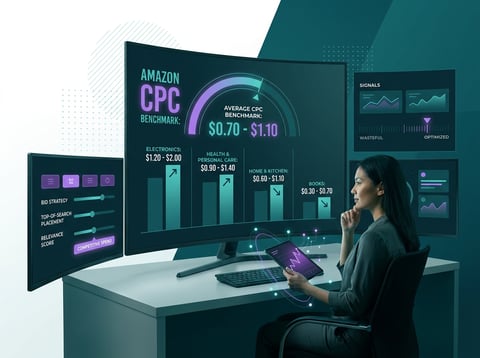
If you want to learn more about the cost factors and performance benchmarks for Amazon ads, see What is the average cost per click for Amazon ads?.
How does Amazon AMS work and how does it fit into an overall Amazon ads strategy?
Amazon AMS (Advertising Management Services) is Amazon’s advanced suite for brands seeking greater control and sophistication. AMS integrates with Sponsored Products, Sponsored Brands, and Display, offering:
- Enhanced reporting and analytics
- Granular targeting and placement options
- Strategic planning tools for scaling campaigns
AMS is the backbone of enterprise-level strategies, supporting everything from compliance monitoring to advanced market share analysis. SupplyKick’s full-service team leverages AMS to deliver both strategic planning and flawless execution—see our Amazon ads strategy pdf for more on this integration.
With AMS, brands gain access to deeper insights into customer behavior, including attribution windows and competitive benchmarking. This enables more precise audience targeting, such as retargeting recent shoppers or building lookalike audiences based on high-value customers. Advanced features like A/B testing of creative assets and automated budget reallocation ensure that campaigns adapt dynamically to changing market conditions. For brands managing both Seller Central and Vendor Central accounts, AMS provides a unified view, streamlining cross-account optimization and reporting.
For a detailed look at Amazon's marketing services, visit What is Amazon marketing services?.
What platforms does Amazon advertise on?
Amazon Ads aren’t limited to Amazon.com. Brands can reach shoppers across:
- Amazon.com and mobile app: The primary marketplace for Sponsored Products and Sponsored Brands
- Amazon DSP (Demand-Side Platform): Extends reach to third‑party sites, apps, and streaming services
- Fire TV, Twitch, IMDb TV: For video and display ads targeting engaged audiences
Amazon ads strategy example: A CPG brand used Sponsored Display to retarget shoppers on Amazon.com and Amazon DSP to re-engage them on external sites, resulting in a 25% lift in repeat purchases. Multi-platform advertising maximizes reach and reinforces your brand at every touchpoint.
Expanding your strategy beyond the core marketplace allows for a full‑funnel approach, capturing demand both on and off Amazon. For instance, leveraging Amazon DSP enables brands to build awareness through programmatic display and video ads, while Sponsored Products and Sponsored Brands capture high‑intent shoppers closer to the point of purchase. Integrating these platforms with proactive compliance and brand protection tools—such as listing hijack monitoring and case auto‑raising—ensures that your ad investment is protected from unauthorized sellers and listing issues that could derail campaign performance.
What are some common challenges that Amazon consultants help businesses overcome?
Brands often struggle with:
- Wasted spend due to poor targeting or bid mismanagement
- Fragmented campaigns lacking integration across ad types
- Difficulty scaling from tactical campaigns to strategic programs
Expert consultants like SupplyKick solve these problems with holistic planning, advanced analytics, and a relentless focus on measurable results. Our Amazon Ads case studies showcase how we’ve helped partners overcome these hurdles, leveraging our verified partner status and 60% average conversion rate increase as proof points.
Another frequent challenge is maintaining brand control while scaling advertising efforts. Many agencies operate with a takeover mentality, but a true partnership model—where your team retains account, inventory, and pricing control—empowers brands to make agile decisions without sacrificing oversight. Consultants also address operational pain points like suppressed listings, FBA auction changes, and evolving restock limits, which can all undermine ad performance if not proactively managed. By providing cross‑account insights and benchmarking against best‑practice patterns from multiple brands, consultants help identify new growth opportunities and mitigate risks before they impact your bottom line.
If you’re considering expert help, see What is an Amazon ad consultant? for more on what consultants offer.
Amazon ads strategy in action: Case studies and next steps
Real‑world Amazon Ads case studies speak volumes. For example, a consumer goods brand partnered with SupplyKick to overhaul their fragmented campaigns—integrating Sponsored Products, Brands, and Display, optimizing targeting, and reallocating budget. The result? A 50% increase in ROAS and a 35% reduction in wasted spend.
A sophisticated Amazon ads strategy is not just a nice‑to‑have—it’s essential for long‑term brand growth. Building and executing a strategy this advanced is a full‑time job, and it’s exactly what SupplyKick delivers for our partners.
A key differentiator in successful campaigns is the integration of AI‑powered account management. Intelligent agents now monitor campaign performance 24/7, surfacing actionable insights and automating routine optimizations. This not only accelerates reporting and opportunity identification by up to 80% but also ensures that your campaigns adapt in real time to shifts in competition, seasonality, or compliance requirements. Brands leveraging this technology see measurable improvements—such as a 60% average increase in conversion rate and 96% partner retention—demonstrating the tangible impact of next‑generation tools and collaborative partnerships.
According to a recent industry report, automation in Amazon ad management yields substantial gains—including a 42% median reduction in ACoS and a 124% median increase in ad-attributed revenue at flat spend—underscoring the power of AI-driven optimizations.
Unlock the full potential of your brand with Amazon Advertising and stay ahead in the competitive e‑commerce landscape. Dive deeper into our expert resources to discover proven strategies and actionable tips for maximizing your ROI. Start optimizing your Amazon campaigns today and watch your business grow! For more, explore our advertising services, Amazon PPC Management, and Amazon PPC Agency pages, plus supporting blog posts in this cluster.
Ready to accelerate your Amazon ads strategy and achieve measurable results? Connect with our team to see how a flexible, data‑driven approach can transform your marketplace performance and empower your brand for sustained growth. Let’s talk.



/Logos/SupplyKick/SupplyKick-Logo_White.svg "SupplyKick-Logo_White")