/Logos/SupplyKick_Logo.svg "SupplyKick_Logo")


Choosing between Fulfilled by Merchant (FBM) and Fulfilled by Amazon (FBA) isn't just a logistics decision—it reshapes who owns the day-to-day work of shipping and supporting customers. If you're weighing the operational trade-offs in the Amazon FBM vs FBA debate, understanding these duties is central to a smart Amazon FBA and Fulfillment strategy. The gap between the two models is wider than most brand teams expect, and it directly affects your workload, your margins, and your account health.
How do the shipping and customer service responsibilities differ for FBM sellers compared to those using FBA?
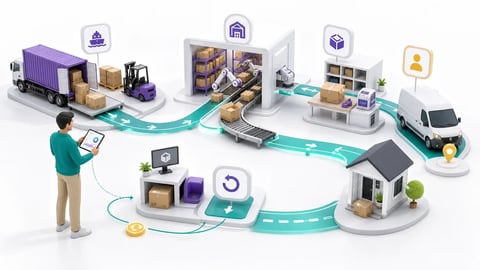
How do the shipping and customer service responsibilities differ for FBM sellers compared to those using FBA? The short answer: FBM sellers own nearly everything, while FBA sellers hand the heaviest lifting to Amazon. With Fulfilled by Merchant, you list products for sale in the Amazon store and fulfill orders from your own facilities, which is why the model is often described as one where you handle everything after the sale—inventory, packaging, shipping, and customer service included. As an FBM seller, you are on the hook for the full fulfillment lifecycle:
- Setting up and maintaining shipping methods, transit times, and delivery regions
- Building and updating your Amazon fbm shipping template so rates and handling times display correctly at checkout
- Selecting carriers, negotiating rates, and printing labels
- Answering every customer inquiry, from "where's my order" to product questions
- Processing FBM returns, issuing refunds, and reconciling inventory
FBA sellers, by contrast, ship inventory into Amazon's fulfillment network once and let Amazon pick, pack, ship, and support each order. The operational deep-dive matters here: FBM gives you control and often lower per-unit fees, but you absorb the logistics, staffing, and communication burden yourself. FBA trades control for convenience, converting recurring operational labor into predictable fulfillment fees.
Does FBA handle customer service?
Yes—and this is one of FBA's biggest advantages. For any order fulfilled through its network, Amazon fully manages customer service, including buyer inquiries, returns, and refunds. Shoppers contact Amazon directly, Amazon resolves the issue, and you rarely touch the interaction. That coverage extends to Amazon's own returns processing and refund decisions, which are handled against its published policies. FBM offers no such safety net, since sellers are expected to build their own post-order management of customer support and returns processes rather than relying on Amazon's infrastructure. Every touchpoint—messages, complaints, refund negotiations, and return logistics—lands on your team. That difference in customer service ownership is exactly why FBM feels lightweight until order volume climbs, at which point the operational complexity compounds quickly.
What are the typical costs associated with handling shipping and customer service independently as an FBM seller?
FBM's "lower fees" reputation can be misleading once you tally the true cost of doing it yourself. Real expenses include:
- Shipping supplies: boxes, mailers, tape, labels, and dunnage
- Carrier fees: postage and freight, which rise with dimensional weight and distance
- Labor: staff hours for picking, packing, and manifesting orders daily
- Customer service labor: agents to answer messages and meet response windows
- Returns handling: the cost of processing FBM returns, inspecting items, restocking, and refunding
The hidden costs are the ones that sting most. Managing inquiries and returns in-house means salaries, software, storage space, and the opportunity cost of pulling your team away from growth work. FBA bundles pick-pack, shipping, storage, and customer service into per-unit and storage fees—an all-inclusive rate that's easy to forecast. FBM can win on unit economics for bulky, slow-moving, or high-value items, but only after you honestly account for the fully loaded overhead.
How do the expectations and response times for customer inquiries and returns differ between FBM and FBA?
Amazon holds FBM sellers to strict service-level expectations. You're generally required to respond to buyer messages within 24 hours, including weekends and holidays, and to ship within your stated handling time. Miss these SLAs and your Order Defect Rate, late shipment rate, and overall account health suffer—metrics that can suppress the Buy Box or trigger account reviews. FBA sidesteps this entirely. Amazon delivers fast, automated responses, processes returns through its own workflows, and shoulders the performance metrics tied to fulfillment. For FBM, every inquiry and return is a manual task with a clock running. That constant vigilance is manageable at low volume but becomes a genuine operational risk as your catalog and order count grow.
What tools or third-party solutions are available to help FBM sellers streamline their shipping and customer service?
Plenty of software exists to lighten the FBM load. Multi-channel shipping platforms like ShipStation and Shippo automate label creation, sync your Amazon fbm shipping template, and rate-shop carriers. Order management systems centralize processing across channels, while help-desk tools and Amazon-approved messaging automations speed customer replies and enforce response windows. Returns-management apps streamline authorizations, refunds, and restocking. These tools meaningfully reduce manual work—but they don't eliminate the responsibility, and they add subscription costs and setup time. Brands that would rather remove the burden altogether often shift to FBA or partner under a wholesale model, where SupplyKick purchases and manages the inventory and absorbs fulfillment and service end to end.
The right fulfillment choice comes down to how much operational ownership your team can sustain profitably. Master these trade-offs, and you can scale on Amazon with confidence—streamlining operations, protecting your margins, and freeing your team to focus on growth. For a broader view of how fulfillment strategy fits into your overall listing approach, explore How do I optimize my Amazon listing? or reach out with your questions today.


/Logos/SupplyKick/SupplyKick-Logo_White.svg "SupplyKick-Logo_White")